By Brian Morris, MD
The four column process provides the framework of how to bring healthy habits to life. As you learn about healthy habits, you will notice that some habits seem fairly easy to implement while others seem more challenging. This is a highly personal process as the same habit may be easy for some people while challenging for others. The key to this process is to take note of your experiences. Which habits seem easy for you? Which ones present challenges? This process will help you decide which habits to begin practicing in your life.
Before making a list of healthy habits you want to practice, take out a blank piece of paper and divide it into four columns as illustrated below. Use this paper to create a handwritten plan for implementing the habits. I recommend performing this process by hand as studies have shown that learning is optimized by writing things down rather than typing them into a computer, tablet, or smartphone. However, if you prefer to create your list through digital means, that can be helpful as well.
1. List the habits in one of four columns on the “menu” as follows:
• Column One: includes the healthy habits that you’re already practicing consistently and are already integrated into your routine.
• Column Two: includes the healthy habits that you’re ready to practice at the current time.
• Column Three: includes the healthy habits that you want to practice but aren’t yet ready to attempt.
• Column Four: includes the healthy habits that, for whatever reason, you don’t want to practice.
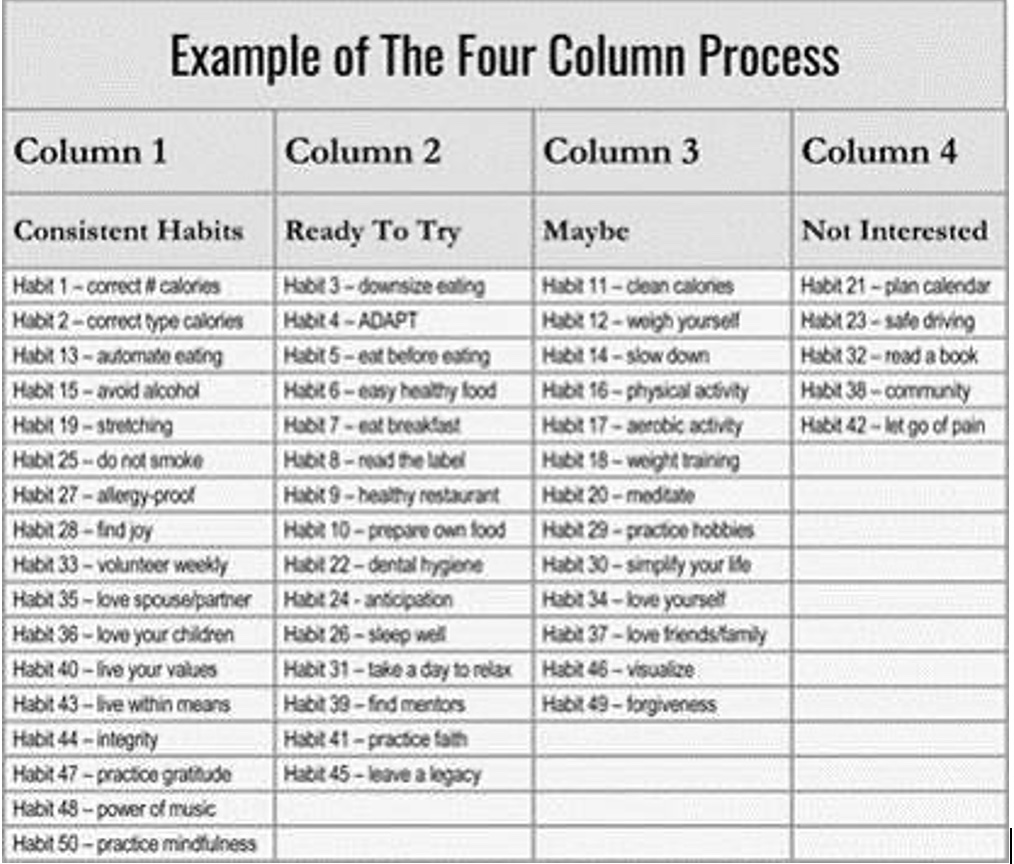
Sorting the habits into these columns will help you see what changes are most important to you and which changes you’re most ready to tackle. I recommend using a pencil rather than a pen as you will be shifting habits to different columns over time. In addition, I suggest you keep this list visually prominent to you if possible—perhaps on your refrigerator door, at your desk, on your nightstand, as the screen saver on your phone, or on your bathroom mirror. The key here is to find a way that you will be prompted to review your list on a consistent basis.
Once you have the habits sorted into the four columns, review the list with a focus on columns two and three. First, review the second column, which are the habits that you’re ready to practice on a consistent basis. Make note of what you’ll need to implement each of them. For example, let’s say you want to incorporate the habit of eating a healthy breakfast each day. What would you need to do to make this a reality? Do you need to consistently go to the grocery store or farmer’s market to stock your kitchen with some new breakfast items? As you review column two, make a separate list of everything you need to make each habit a reality.
Sometimes as you do this, you realize that items that you initially placed in column two truly belong in column three (or vice versa). Once you finish reviewing the habits in column two, move on to column three which are the habits that you’re not quite ready to practice. For each item, list reasons why you’re not ready to practice it consistently. Is it a time issue? Is it a family issue? Is it a motivation issue? Is it a scheduling issue? List all the reasons for each habit and think about these reasons and whether any of them can be overcome.
Finally, take a look at the fourth column which lists the habits that you don’t want to adopt. For the fourth column, list the reasons why you don’t want to change each habit. Many times, the habits listed in the fourth column provide insight into your priorities.
This four-column exercise is helpful in understanding which habits are realistic for you to address. I recommend that you perform the four-column process on the first of every month and adjust your four columns as discussed above.
Over time, you’ll find that some habits shift to the left towards column one. Some habits will move quickly while others take more time. Don’t get frustrated if things don’t progress as quickly as you’d like. Lasting change takes time and is not a quick-fix program. Rather, it is a long-term plan that helps you slowly move forward to a healthier place.
2. Order From The Menu
Now that you’ve created your columns (or updated them each month), the next step to create your plan for the month. I call this process “ordering from the menu.” To do that, review the first two columns as if reviewing a menu at a restaurant. Take a look at your four column “menu” and start by reviewing the first column, which contains the habits that are already a part of your life. Double check to ensure that all of these habits still belong in column one and haven’t regressed into column two. Then review the habits in column two and pick two habits that will be your habits for the month. I generally don’t recommend working on more than two habits at once. It’s usually best to pick the habits that are the easiest to incorporate into your daily life. Just as it’s easier to pick apples from the bottom branches of a tree, these are the habits that are most “ripe” and ready to be incorporated into your life. “Low hanging fruit” are the habits that are easiest to integrate into your life at the current time. That being said, you should also prioritize the habits that are most important to your life circumstances.
On the other hand, if a habit appears too difficult at this time, put it on the back burner. You can consider it again in the future. Don’t try to force yourself to work on a habit before you are ready, as that is a setup for failure. Focus on the habits that are ripe and pick those.
Once you’ve selected your two habits for the month, spend a little time to figure out how you will practice those habits on a consistent basis and also think about how you will integrate them into your life. Remember that practice and integration are the keys. How will you get these two habits to be a part of your life? How will you make these habits a part of who you are?
You adopt these habits by making small changes so they become a part of your routine. The changes you make shouldn’t seem external to you. If you feel like you are twisting yourself into a completely different person to follow a program, then stop and re-evaluate. The goal isn’t to create a “new you” but rather to make small adjustments in who you are so the changes are likely to stick for the long-term.
Next, spend the month working to integrate these two habits into your life. Your goal for the month is simply to do the best you can with the goal that these two habits will become a part of your routine by the end of the month. Don’t try to be perfect. As you progress through the month, stay engaged with how things are going. What’s working? What’s not working? If necessary, make adjustments in your routine. Be honest with yourself and maintain communication with those who are close to you. Enlist support for encouragement and accountability whenever possible.
When the month ends, review how you did with the two habits of the month. If you succeeded with integrating these two habits, congratulations! It’s wonderful if both habits are now part of your routine, but don’t stress if they aren’t. If the two habits aren’t yet a part of your routine, remember that change takes time and doesn’t always happen right away. For example, the average smoker tries to stop smoking seven times before finding long-term success. If you didn’t do as well as you had hoped, brainstorm for ideas that may help you succeed with these habits in the future. If you think of changes you’ll need to make to have success with these habits, do your best to make those changes.
Either way, start your next month by doing your monthly four column review. Review all the habits and move them between columns if any circumstances have changed. Think about each of the habits and make a fresh assessment of each one. As before, focus on the habits in column two and choose two new habits for the next month. You may choose to work on the same two habits as the prior month or you may want to start with two fresh habits. I usually counsel my patients to stay with the same two habits from the prior month if progress was being made. However, trust your instincts with this. Go with the habits that you feel ready to tackle given your current circumstances.
If you find that several months have gone by and you still seem to be struggling with a certain habit, then think seriously about whether this habit truly belongs in column two. Perhaps it really belongs in column three. Regardless of what you decide, be sure to choose two habits for each month and get started again.
Don’t beat yourself up if adopting a given habit is more difficult than you think it should be. It’s best to accept that you’re going to struggle with some of these habits. As mentioned, focus on the habits that are most attainable to you. The great news is that as you grow and progress, habits that previously seemed impossible will likely become easier to achieve.
This process repeats monthly, each month will provide you with a new opportunity to make two habits a reality. As I’ve mentioned, this is a long-term process. Keep striving to improve your habits while at the same time embracing and accepting that no one is perfect.